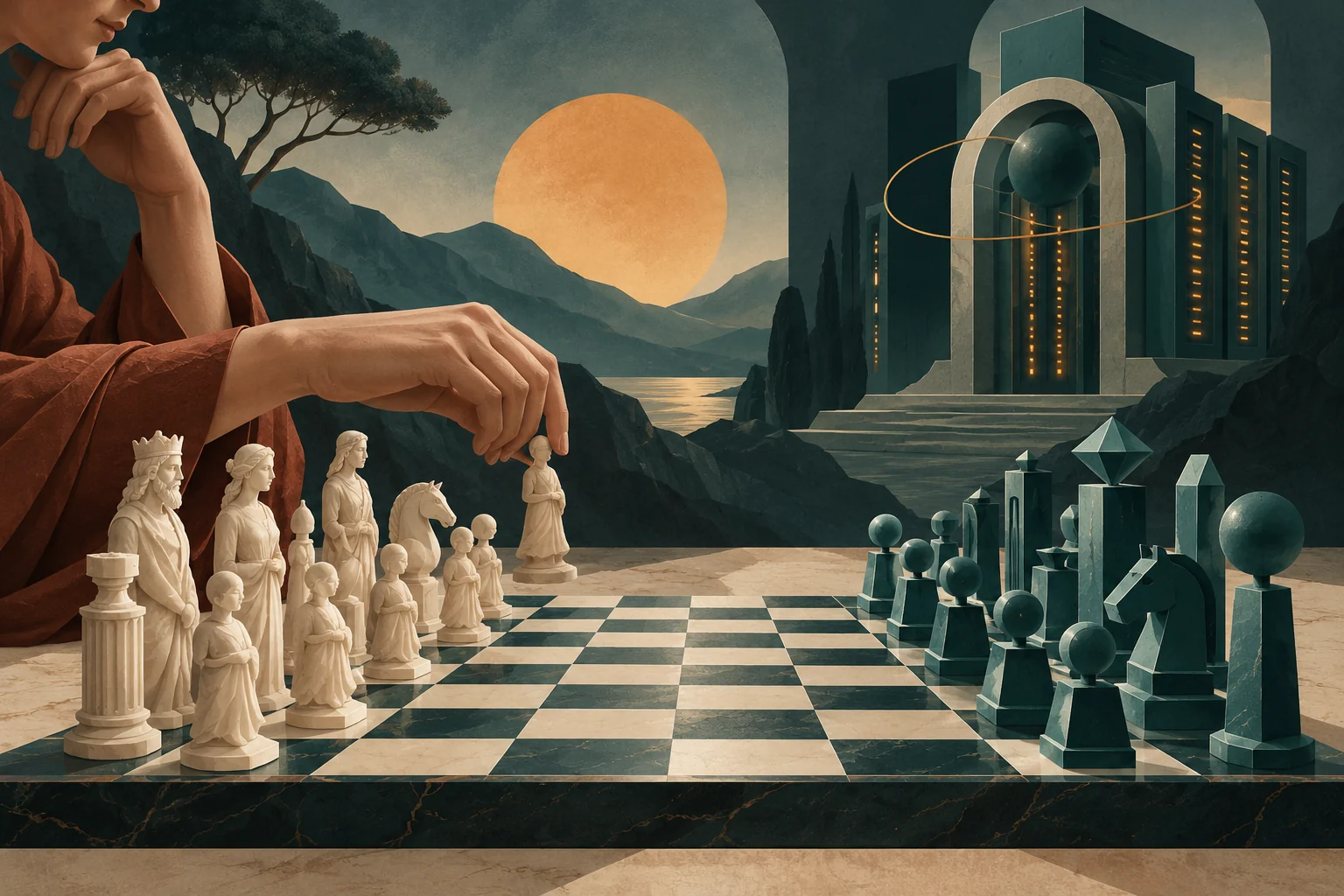
The board-game maxims emphasize economical moves, attention to details, time and the changing position. They also warn that advancing without adequate defense exposes weaknesses.
Draw a small decision tree
A board game has specified legal moves; a market does not offer the same complete information. Still, considering responses can prevent one-sided reasoning. List plausible responses and your constraints, keeping unknown incentives labeled as unknown.
Worked example
In a fictional negotiation, demanding immediate acceptance may win speed but encourage the other party to withdraw. Looking only at the desired response misses that branch.
Case connection
A chess move invites a reply. Use this documented contest to practice branching analysis, while remembering markets have less complete rules.
Deep Blue meets Kasparov
Source-grounded facts
IBM’s Deep Blue defeated world chess champion Garry Kasparov in a six-game match.
Context
IBM set out to build a chess computer capable of beating the reigning world champion. The contest gave both sides a clearly defined board, legal moves and tournament time controls.
Outcome
Deep Blue won the match 3.5–2.5. This demonstrated a specific competitive capability under chess rules, rather than proving superiority at every activity requiring judgment.
- In 1996, Deep Blue won the first game, but Kasparov recovered to win the six-game match 4–2.
- The team improved the computer’s evaluation function and endgame databases before the rematch.
- In May 1997, each side won one early game and the next three were drawn. Deep Blue then won the sixth.
Case analysis
A move changes the choices available to the other player. Draw two plausible replies and the position each creates before choosing your preferred branch. Chess makes this exercise concrete; in a market or negotiation, label unknown intentions as unknown. The point is to avoid assuming that other participants passively deliver the response your plan requires.
Try it
Draw your proposed action and two plausible responses. For each branch, note the next decision you would face.